
Bay County Mugshot Public Records
A booking photograph records the person’s appearance during the intake process. Release does not transform the image into evidence of present custody. Michigan’s official FOIA case guide summarizes Patterson v Allegan County Sheriff, 199 Mich App 638; 502 NW2d 368 (1993), as treating a sheriff-held county-jail booking photograph as a public record that could not be withheld under the privacy rationale asserted in that case.
That authority supports a focused request for an existing Bay County Jail booking photograph. It does not force the Sheriff to create an online gallery, preserve an image beyond the governing schedule, disclose a sealed or nonpublic record, or ignore another lawful exemption. A record can also be redacted after review. The photo establishes a past booking image, while a jail release form, court docket, VINE event, or OTIS status answers the different question of release.
Public-record limit: A Bay County mugshot does not establish guilt, current custody, or the present status of a case. Confirm those facts through the originating court and agency records.
Find Bay County Released Mugshots
No single system holds every Bay County release mugshot. The correct channel depends on whether the photo came from the county jail, MDOC, or a public incident notice. The absence of a web gallery makes the Bay County FOIA route especially important.
| Channel | Has a photo? | How to access it |
|---|---|---|
| Bay County jail website | No released-person photo field was verified | Use the official jail page for current-custody directions, then request the record |
| Bay County FOIA | An existing booking photograph may be requestable | Submit a focused request through the county portal, email, mail, or in person |
| MDOC OTIS | Many MDOC profiles show an offender image | Search the state record and confirm identity; some older files lack an electronic photo |
| MDOC FOIA | An available offender photograph may be supplied | Request the specific image and release or discharge record |
| Michigan VINE | Photo availability is not assured and the service is status-focused | Use it for custody checks and alerts, not as a photo archive |
| Sheriff social and local news | Some notable incidents include a photo | Treat the item as a lead, then verify the source and current status officially |
| Third-party copies | They may preserve old images | Do not rely on them for release, identity, or current case status |
The source agency matters. An OTIS image belongs to an MDOC record and is not necessarily the photograph taken at the Bay County Jail. A person who served only a local sentence may never have an OTIS profile. Conversely, a state offender image can remain visible after the person leaves prison, subject to OTIS retention and later legal changes.
No Bay County Release Gallery
The official sweep found no Bay County web roster, recent-release feed, or released-person photo gallery. The Sheriff’s jail-information page directs present-custody inquiries to Michigan VINE or telephone staff. It also says information about previous incarceration is not divulged without proper authority. That structure means a former jail detainee’s booking photo should be sought as a record, not through an invented photo-search feature.
No official Bay County Sheriff inmate or release mobile app was verified either. Bay City Public Safety has a city safety app for alerts, tips, and police or fire resources, but it is not documented as a county jail mugshot product. GettingOut or ViaPath supports jail communications and visitation. It is not a released-inmate photo source or proof that someone left custody.
The Bay County 24-hour jail release route explains the same absence for recent-release names. A precise daily-summary request can identify a date range, while the individual inmate jacket is the better target for one person’s photograph and release form.
Note: Bay County offers no verified online mugshot gallery, so a search-result page claiming completeness should not replace the county record.
Request a Bay County Booking Photo
Bay County accepts records requests through its online FOIA portal. It also lists email, fax after confirming delivery, mail, and in-person delivery. A useful request names the person, gives a birth date if known, narrows the custody dates, and asks for the existing booking image with the associated inmate jacket or release form. Precision helps the county locate the record without being asked to create a new compilation.
- Open the Bay County FOIA portal and choose the option for a new request.
- Identify the record as a Bay County Jail booking photograph for a named person and a limited booking date range.
- Ask for the inmate or booking number, booking date, release form, actual release date and time, release destination or disposition, and photograph when those existing records are available.
- Request electronic copies. State that the county may provide the existing record without creating a new report if a requested field is not maintained.
- Review any partial denial or redaction explanation and use the listed appeal route if needed. Court records must be requested through the court rather than county FOIA.
The county’s published procedure treats an electronic request as received one business day after transmission. Bay County must respond within five business days by granting, denying, partially granting, or issuing a permitted extension. One written extension can add up to ten business days. These are response deadlines, not promised image-delivery dates.
The county may charge lawful labor, redaction, copy, and mailing costs. If an estimate exceeds $50, a deposit of up to half may be required. Do not use the Sheriff Records Division’s published $22 closed-incident-report price as a mugshot fee because the official page does not establish that amount for a booking photo.
The official Bay County new-request interface displays the electronic request and delivery choices.
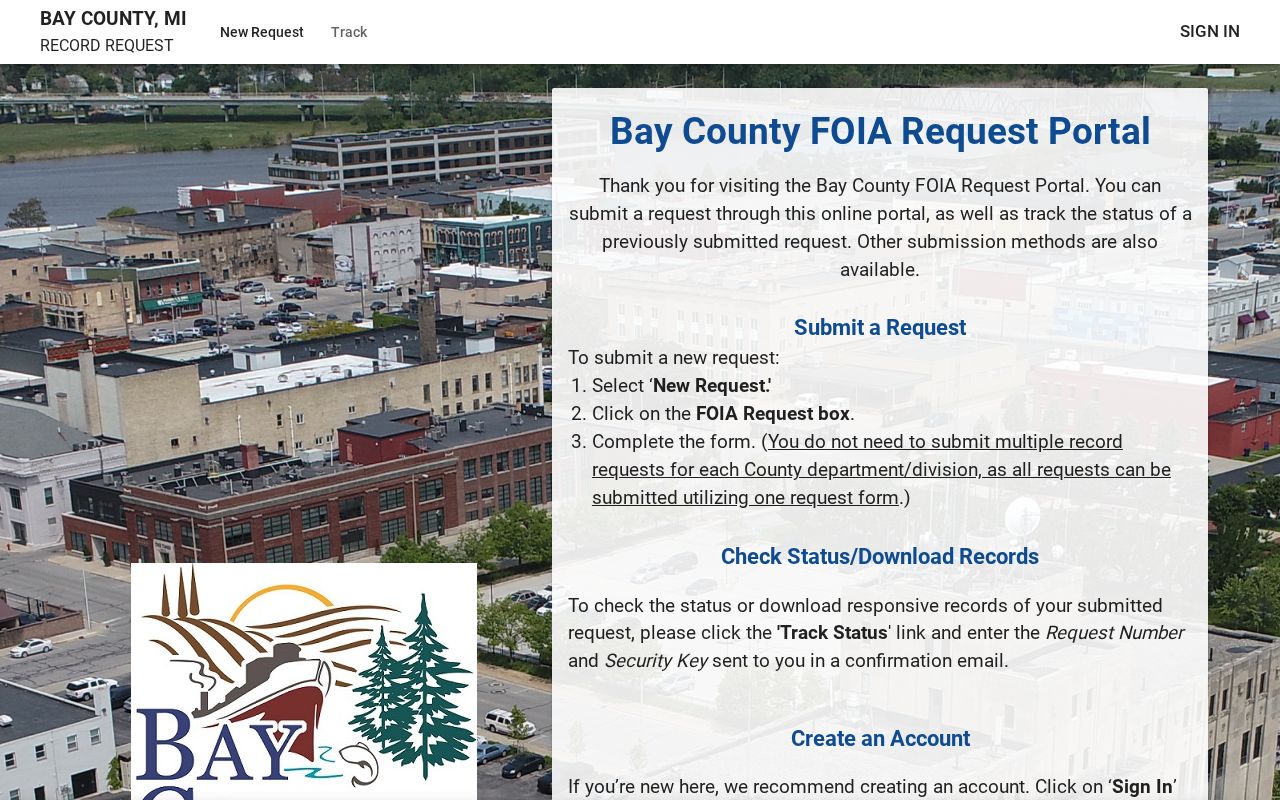
A narrow description helps route the request to the jail record that actually contains the photograph.
Bay County Mugshot Retention
Michigan General Schedule 11 describes several local law-enforcement records. Item 11.210 says an inmate jacket may include a mug shot and inmate release form and authorizes retention until release plus ten years. Booking or control-center logs have a calendar-year-end-plus-seven-year authorization. Property records and daily count summaries have shorter periods.
A retention schedule is a disposal authorization, not an online-publication term or a guarantee that each field exists. An agency may also have a more specific schedule or legal hold. Still, the ten-year inmate-jacket category gives a Bay County photo request a clear record name and supports filing before the possible disposal date. A requester seeking a much older record should ask whether another approved schedule, archive, or court record applies.
Bay County MDOC Offender Photos
OTIS covers people under MDOC jurisdiction and many discharged profiles within the public display period. Search by MDOC number when available, or by last name and refinements. Compare the MDOC number, birth details, conviction, court, and physical description before treating the image as the correct person. Names can change, and similar names are common.
An OTIS profile can show an offender image, status, sentence data, Date Paroled, and discharge information. The picture is an MDOC image. It does not prove which county made an earlier booking photo, and it should not be described as a Bay County Jail mugshot without direct support. Some older MDOC profiles lack an electronic image. Public OTIS records may also leave display three years after discharge.
The official OTIS result format can display a released or discharged status together with an MDOC offender photo and sentence fields.
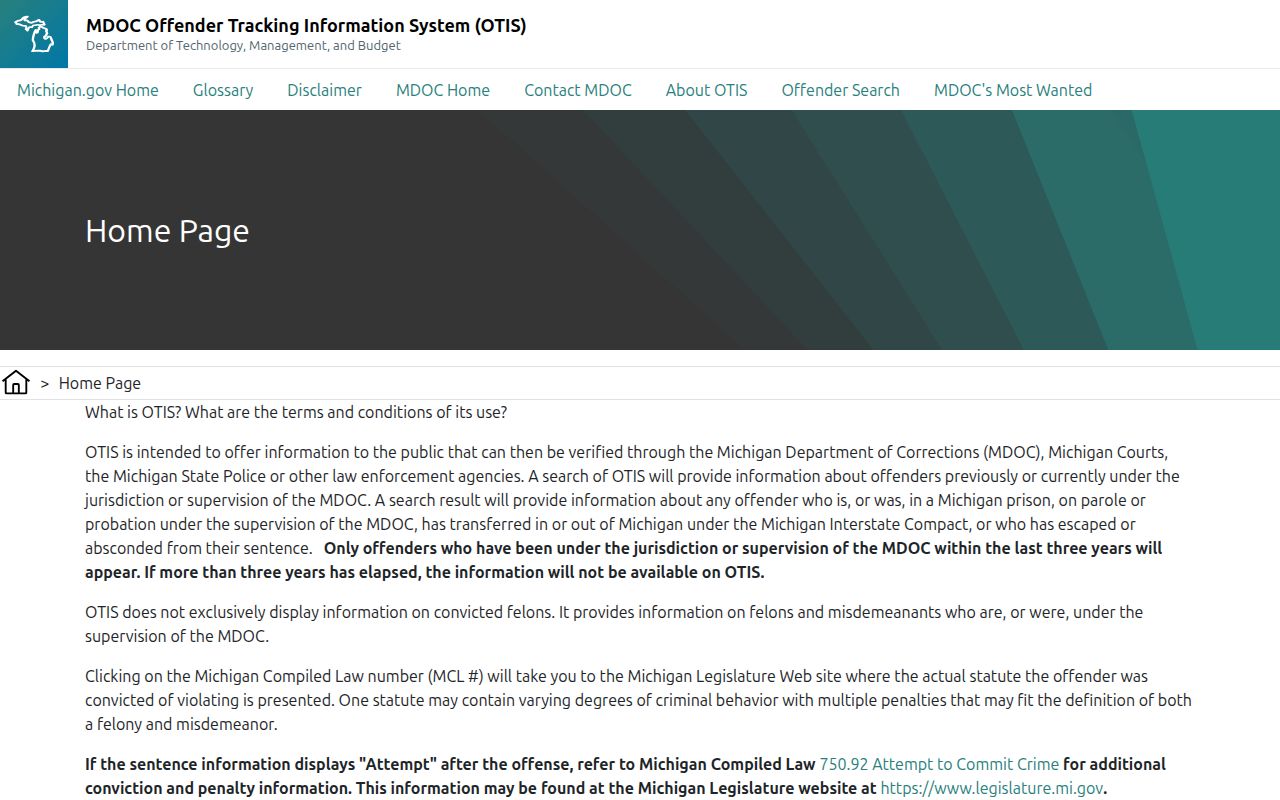
The example demonstrates the state record format only and must not be represented as proof of a Bay County Jail release.
When the image is not public in OTIS, an MDOC FOIA request may seek an available offender photograph with the discharge or release record. Send a specific request to MDOC using the person’s name, birth date, MDOC number, and dates. The public should not request a PENPACK, which MDOC limits to recognized criminal-justice authorities for official use.
Bay County Set-Aside Effects
Michigan’s set-aside process can make a conviction record nonpublic. Under MCL 780.623, an order setting aside a conviction generally makes the record nonpublic except for the uses allowed by law. That can change what an official office or public system may provide. It does not guarantee that every uncontrolled copy disappears from the internet.
The correct first step is to confirm the actual order through the Michigan courts’ Clean Slate information and the court that entered it. Then present the order to the government office controlling the official record. An official source may need time to update its index or determine what the order covers. The arrest, booking photograph, court file, and conviction entry are related records but not always governed identically in every situation.
The research sweep did not verify an enacted statewide Michigan commercial-mugshot anti-pay-to-remove statute. That limited finding should not be read as approval of a paid removal service. Avoid paying an unknown publisher merely because it claims control over a photo. An official set-aside order and the originating agency are the sound paths for an official record.
Verify Bay County Photo Identity
A photo is not enough to establish identity. Match at least two independent details such as date of birth, booking or MDOC number, court case number, middle name, or conviction information. If the image came from OTIS, confirm that the state conviction and physical description match. If it came from a Bay County record, use the booking number and custody dates.
Next verify the release separately. A current-custody VINE result can show whether Bay County still reports the person in custody. A court docket can explain bond, dismissal, sentence, or transfer authority. The actual release form supplies the time and destination. A transfer entry means the person left Bay County custody for another agency and should not be labeled free.
The Bay County released-inmate search and release-record process joins these sources for one named person. A booking photo remains a historical image even when the release record proves the person left custody.