
Bay County Scheduled and Actual Release
A scheduled or projected date is an estimate or legal boundary derived from a sentence. The actual release date is the day the custodian records the person’s physical exit or transfer. Those dates can differ. A court may authorize release, but the Bay County Jail still must check other police-agency holds and complete processing. For a state prisoner, parole eligibility arrives before the Michigan Parole Board decides whether release is suitable.
Scheduled versus actual: An OTIS eligibility date, a court order, or a favorable parole decision does not prove that a person left custody. Confirm the actual event with Date Paroled, the jail release form, or another official discharge record.
A Bay County pretrial detainee has no computed sentence release date. The case may change through bond, dismissal, plea, trial, sentencing, or another order. Even when bond is posted, Bay County requires all other police-agency holds to clear. A transfer to MDOC or another custodian is an exit from the jail, but it is not freedom in the community.
Find a Bay County Projected Release
Start with the custody level. OTIS covers Michigan prisoners and people under MDOC supervision. It does not cover a person who served only a Bay County Jail sentence. County sentence dates and actual jail exits require the court and jail record. A federal sentence uses the Bureau of Prisons system instead.
- Identify whether the person is a Bay County pretrial detainee, county-sentenced prisoner, MDOC prisoner, or federal prisoner.
- For an MDOC case, open the OTIS offender search. Use the MDOC number when known, or search by last name and available refinements.
- Open the matching profile and compare the MDOC number, birth date, physical details, conviction, and sentencing court. Never rely on the name alone.
- Read the Parole Board Jurisdiction Date, also described as the Earliest Release Date, and the Maximum Date. Then check status and any Date Paroled.
- For a county-jail sentence, inspect the Bay County court judgment and ask the jail for the release form or sentence computation when the projected date must be confirmed.
- For a pending case, follow the court docket, bond status, VINE, and the jail. Do not invent a release date from a future hearing.
The Bay County released-inmate records route provides the full court, jail, and records-request path for an actual county release. OTIS remains the main public route for a state-prison date.
The official MDOC OTIS form shows the public search fields used to locate the correct state-prison record.
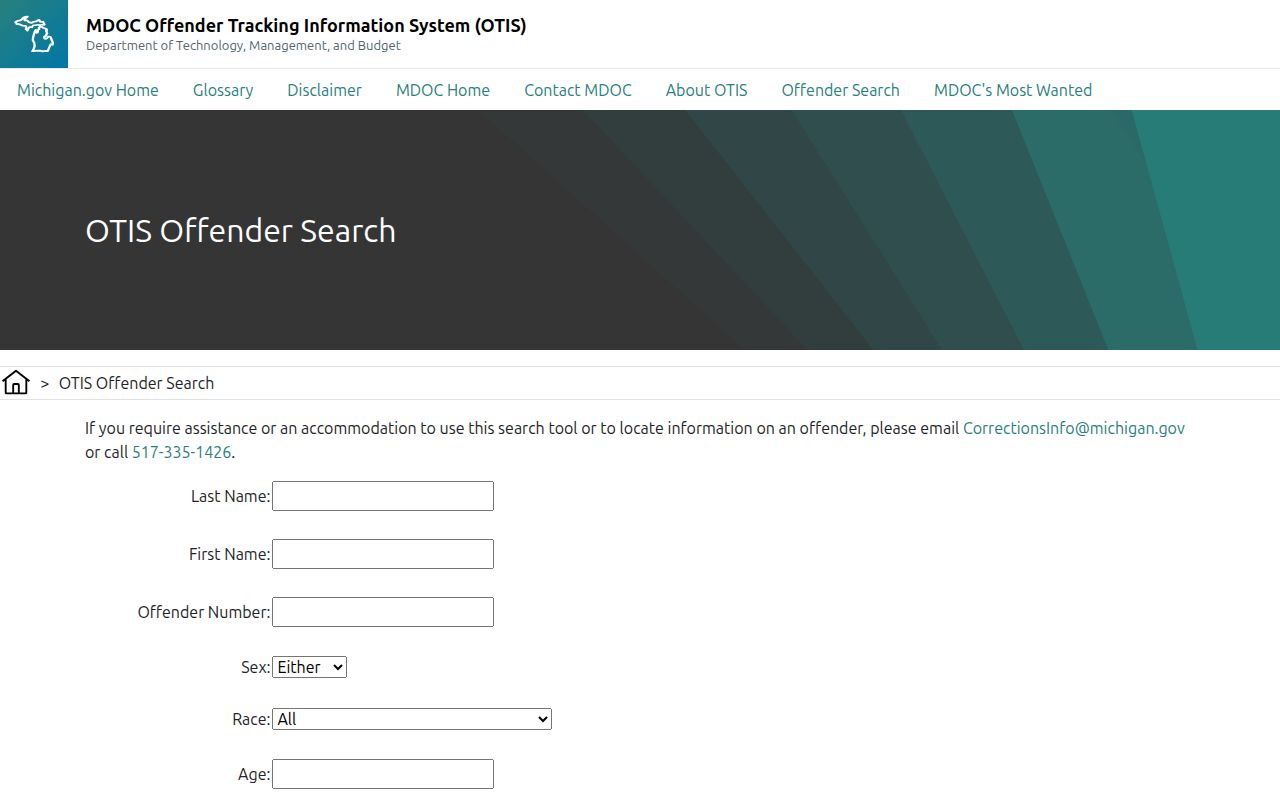
A result must be matched carefully before any sentence date is read as belonging to the person in question.
Bay County OTIS Release Fields
Michigan does not label one public OTIS field as a universal projected release date. The key fields describe different stages. The Parole Board Jurisdiction Date, often called the Earliest Release Date or ERD, is the first date the Board has jurisdiction to grant parole when the sentence permits it. It is not a promise of release. Maximum Date is the potential outside date for the controlling sentence, subject to the governing credits and sentence rules. Date Paroled is retrospective and shows the prison exit to parole after it occurs.
| OTIS field | Meaning | What it does not prove |
|---|---|---|
| Parole Board Jurisdiction Date / ERD | First parole-eligibility point under the sentence | That parole was granted or the person left prison |
| Maximum Date | Potential outside sentence date under applicable rules | The exact expected release day in every case |
| Date Paroled | Recorded date the person left prison on parole | That MDOC supervision also ended that day |
| Discharged | End of the displayed MDOC jurisdiction or supervision | The earlier physical prison-release date |
Probation fields require extra care. OTIS explains that an earliest date for a probationer can describe possible release from supervision, while Maximum Date can represent expiration of the probation order with the greatest end date. Neither is a prison-release date for someone who was sentenced only to probation.
The OTIS field-definition page distinguishes the eligibility, maximum, parole, and discharge terms used for Bay County state cases.
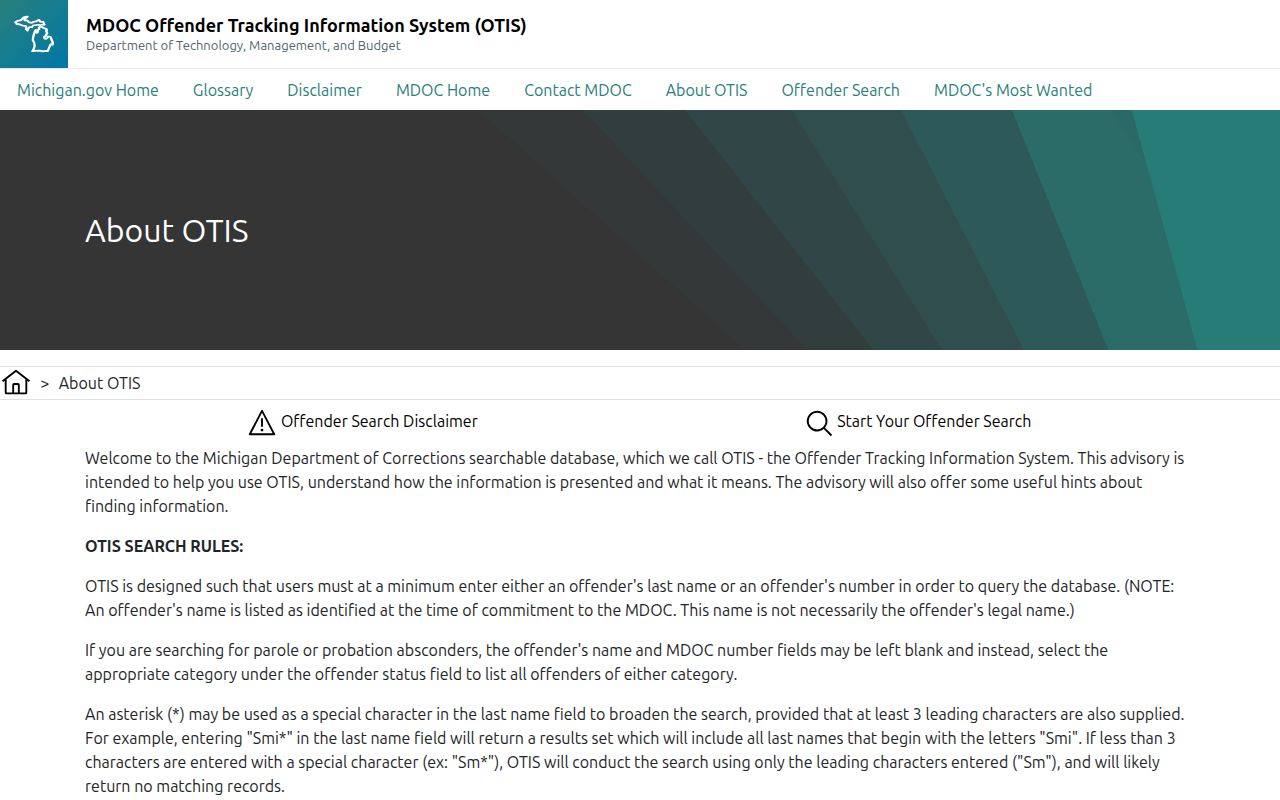
Those definitions are the reason an ERD should never be relabeled as an assured release date.
Michigan Truth in Sentencing Dates
Michigan does not have a sound basis for a generic “85 percent rule” in Bay County cases. For offenses committed after December 15, 2000, Michigan truth-in-sentencing law generally requires service of the court-imposed minimum before parole eligibility without reducing that minimum through disciplinary credits. MCL 791.233, MCL 791.233b, and MCL 791.234 govern the parole framework.
Legacy offenses can involve good-time or disciplinary-credit rules under MCL 800.33 through 800.35. The offense date and exact sentence control. Maximum-date rules also depend on the controlling term and any credit law that applies to it. A broad percentage calculation can be wrong even when the minimum and maximum sentence are known.
Note: Michigan parole eligibility depends on the sentence and offense date, so a single percentage must not replace the official OTIS and court record.
Bay County Jail Good Time
County-jail sentences use a different law from MDOC prison terms. MCL 51.282 provides one day of sentence reduction for each six days of a county-jail sentence when the prisoner has no rule violations. The Sheriff may forfeit or restore the allowance under the statute. MCL 51.283 addresses posted rules and the eligible prisoner calling the entitlement to the sheriff or deputy’s attention.
No Bay County computation worksheet was found in the official material reviewed. That absence matters. Do not guess how a partial six-day period is rounded, when the jail applies a restoration, or the exact hour someone will leave. The sentencing judgment, jail computation, and final release form are the sound sources for one named person.
Pretrial detention is different. A person held before judgment is not serving a county sentence that can be reduced with this good-time formula. Bond, a court order, and any outside hold control release. Time already spent in custody may later be credited by the court, but that does not turn a pending case into a fixed projection.
Bay County Weekend Release Rules
MCL 801.251 provides a weekend and holiday discharge mechanism under its stated conditions. It should not be summarized as a rule that every Sunday sentence date moves automatically to Friday. The precise term, facility, court authority, and statutory conditions must be checked.
Bay County also promises no fixed hour for release. Court transports return as a group, and the Sheriff warns that processing after arraignments may take a couple of hours. A pickup estimate is not a legal date. The actual jail transaction supplies the best time evidence after the person leaves.
Bay County Parole Release Timing
The Michigan Parole Board may begin consideration months before the eligibility point. That early work does not move the ERD. A favorable decision also does not establish an immediate prison exit. MDOC’s parole consideration process says the Parole Release Unit acts after a grant and identifies a minimum 28-day span between the Board’s release decision and physical release.
During that period, MDOC may complete a parole plan, check a proposed residence, resolve program needs, or examine holds. The Board can also rescind a grant before release. A grant and Date Paroled therefore belong to two separate stages. Once the person is released, parole continues the sentence under community supervision until discharge or another official change.
OTIS later supplies the public Date Paroled and status. A victim who is directly registered with MDOC may receive added notices through the Crime Victim Notification Unit, while general VINE registration offers a different release-notification layer.
Why Bay County Release Dates Change
A release date can move for reasons tied to the sentence, the Board, the court, or another custodian. The source of the change determines where to verify it.
| Factor | Possible effect | Verification source |
|---|---|---|
| Parole denial or deferral | The prisoner remains confined past the eligibility date | OTIS and Michigan Parole Board process |
| Parole grant or rescission | Planning may begin, or an expected release may stop | OTIS, Board action, and MDOC record |
| Program or release-plan requirement | Physical release may follow the grant later | MDOC release record |
| Outside hold or detainer | The person may transfer rather than enter the community | Release form and receiving-agency record |
| County-jail rule violation | Good time may be forfeited, subject to restoration | Bay County Jail computation and records |
| Court order or amended sentence | The legal term or release authority can change | Sentencing court record |
| Weekend or holiday statute | Discharge timing may change when exact conditions apply | MCL 801.251 and jail record |
A detainer is a notice that another authority may claim custody. It can cause the person to leave one facility for another. That movement may appear as a release from Bay County or MDOC control without being release into the community.
Confirm a Bay County Release
For an MDOC prisoner, compare the live OTIS status with Date Paroled. For a Bay County Jail release, request the actual release form, timestamp, disposition, and destination. The court order explains the legal basis, but the jail transaction proves when processing finished. For a transfer, the receiving agency’s record continues the custody trail.
Michigan VINE can provide a timely custody-change alert. The Bay County VINELink inmate search explains the one-person search and notification process. Treat an alert as event evidence rather than a certified discharge document. If the exact date matters, preserve the notice and follow it with an agency record.
Older OTIS profiles may disappear three years after discharge. A no-result then calls for MDOC records and the sentencing court, not a claim that the person was never confined. For county releases, Bay County FOIA can request the inmate jacket and release form. Michigan’s local law-enforcement schedule authorizes retention of that jacket until release plus ten years, though lawful exemptions and redactions can still apply.
A focused Bay County request can name the prisoner, approximate booking dates, court case, and any known inmate number, then ask for the sentence computation, actual release timestamp, release disposition, and receiving agency if transferred. Send it through the county’s official FOIA portal or to the Bay County FOIA Coordinator at 515 Center Avenue, Suite 402, Bay City. The county’s response deadline is not a promised release date or delivery date. Court records follow the court process instead of county FOIA, so obtain the sentencing judgment from the 74th District Court or 18th Circuit Court as the case requires.