
Bay County Parole and Probation
Michigan uses several forms of community oversight. They should not be merged into one broad “parole” label. Parole begins when a person leaves an MDOC prison before the maximum sentence has ended and continues serving the sentence in the community. Felony probation is imposed by the 18th Circuit Court and supervised through the Michigan Department of Corrections Field Operations Administration. It can be ordered without a prison stay. Misdemeanor probation follows a 74th District Court judgment and is handled by the court’s own probation department.
Bay County also operates Community Corrections and pretrial supervision. That program concerns a defendant who is allowed to remain in the community while the criminal case is still pending. Pretrial release is not probation, parole, dismissal, or completion of a sentence. The controlling order, court, and agency define the person’s status.
| Type | When it applies | Bay County verification route |
|---|---|---|
| Parole | After release from an MDOC prison while the sentence continues | OTIS status, Bay MDOC office, and the parole record |
| Felony probation | After an 18th Circuit Court felony order, with or without prison | OTIS, MDOC Field Operations, and the circuit court case |
| District probation | After a 74th District Court misdemeanor judgment | District Court Probation and the court register of actions |
| Pretrial supervision | Before final disposition under a court release order | Community Corrections and the pending court case |
- Parole
- Release from state prison to community supervision before the sentence fully ends.
- Probation
- A court-ordered community sentence with conditions, sometimes imposed without incarceration.
- Discharge
- The official end of the displayed term of supervision or MDOC jurisdiction.
- Absconder
- A supervised person whom the responsible agency says has stopped reporting or cannot be located.
Check Bay County Supervision Status
The MDOC Offender Tracking Information System, known as OTIS, is the first public check for MDOC parole and felony probation. Search by MDOC number when available because the number identifies one record. A last-name search can be refined by first name, age, sex, race, status, or physical marks. Open the matching profile and compare more than the name. Date of birth, court information, MDOC number, and conviction details help avoid a false match.
- Identify whether the underlying case is a state-prison parole, felony probation, district probation, or still-pending pretrial matter.
- For MDOC supervision, search OTIS and read both Status and Location. A parole status means prison release with supervision still active.
- For misdemeanor probation, search the 74th District Court record and look for the probation order, violation entries, and a later discharge order.
- For a pending case, review the court docket and contact Community Corrections only when the order places the person in that program.
- When the online record conflicts with known facts, direct a court-derived error to the sentencing court and a supervision error to the assigned office or agent.
OTIS can display probation, parole, discharged, and absconder statuses within its public window. It covers MDOC cases, not every person released from the Bay County Jail. Many short local jail cases never enter MDOC jurisdiction. The broader Bay County released-inmate search and records path explains how to pair the jail record with the court docket when OTIS is not the right system.
The official OTIS search form shows the name, number, and refinement fields used for Bay County parole and probation lookups.
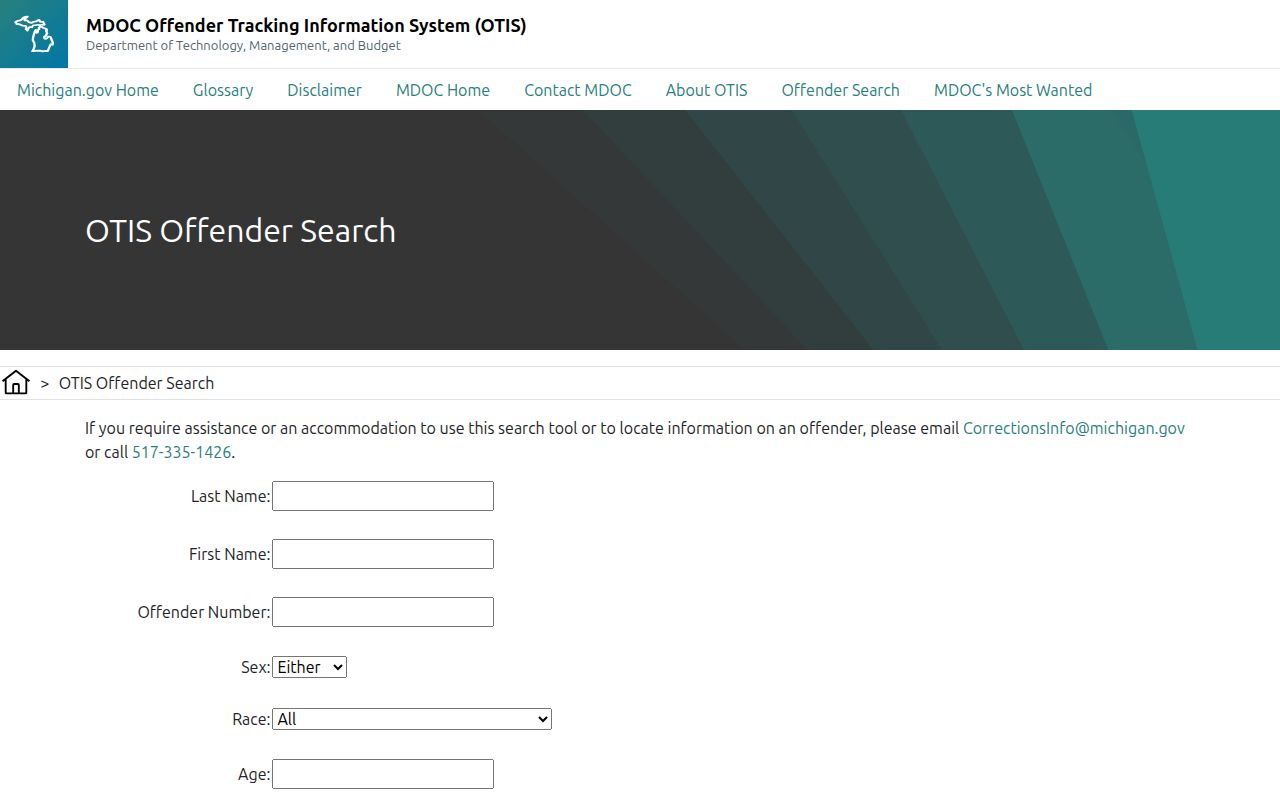
The form is only the starting point. The matching profile and the supervising office must support the same identity and status.
Bay County MDOC Supervision Office
The official MDOC Region 5 directory identifies the Bay County Parole/Probation office as the local route for state parole and felony probation. It can address supervision records and errors after the person and MDOC number are identified. Staff may need to limit case details. Public OTIS data and the court record remain useful when a caller is not entitled to private supervision material.
Bay County Parole/Probation
1230 Washington Avenue, Suite 619
Bay City, MI 48708-5994
(989) 895-4250
Michigan Department of Corrections, Field Operations Region 5
The MDOC Region 5 directory displays the Bay County parole and probation office within the statewide supervision network.
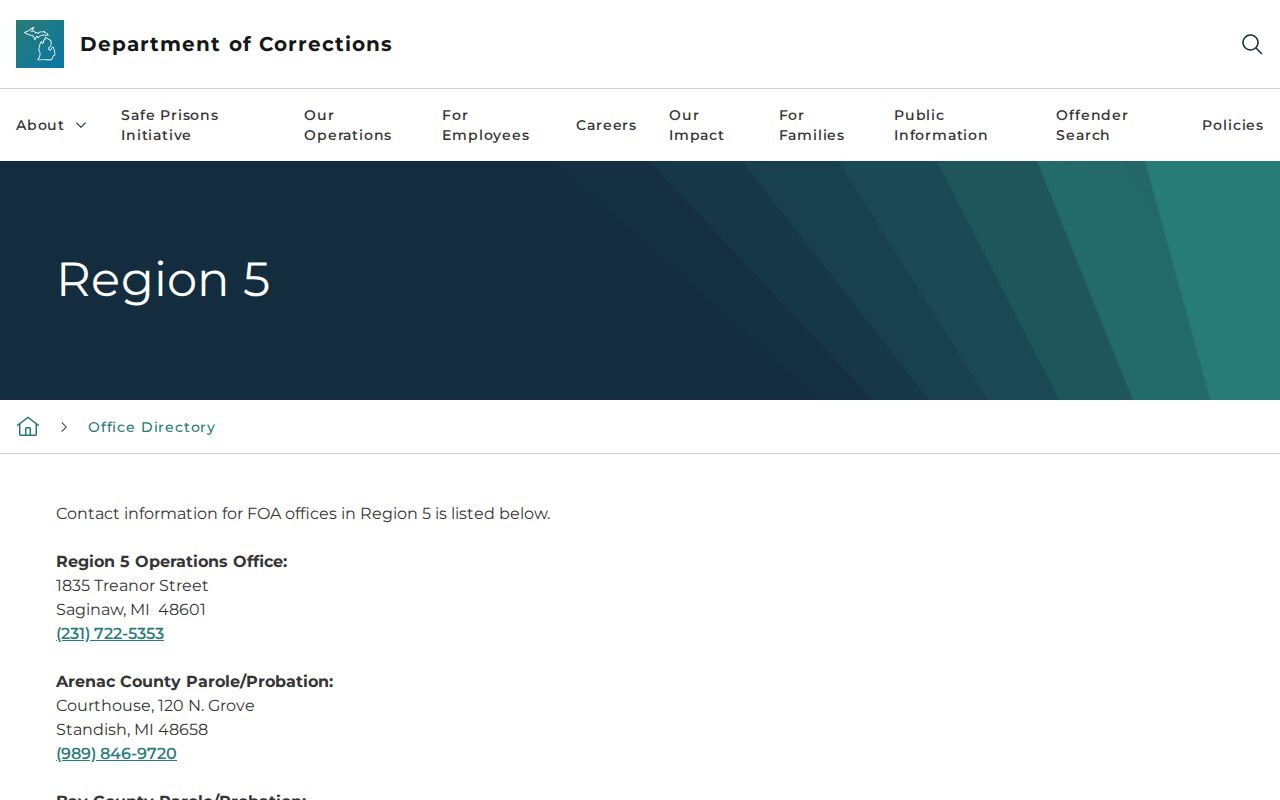
This entry distinguishes the MDOC suite from other programs located in the same Washington Avenue court complex.
Bay County Supervision Office Roles
Three offices at the Washington Avenue court complex perform different roles. The Bay MDOC office in Suite 619 handles state parole and felony probation. The 74th District Court Probation Department in Suite 747 handles misdemeanor probation and publishes assigned reporting windows. Bay County Community Corrections manages pretrial assessment, pretrial supervision, and other qualifying local programs. Co-location does not make the records interchangeable.
| Office | Contact | Use |
|---|---|---|
| Bay MDOC Parole/Probation | 1230 Washington Ave., Suite 619 (989) 895-4250 | State parole and felony probation |
| 74th District Court Probation | 1230 Washington Ave., Suite 747 (989) 895-4275 or (989) 895-4187 Monday through Friday, 8:00 a.m. to 5:00 p.m. | Misdemeanor probation and discharge orders |
| Community Corrections | 1230 Washington Ave. (989) 895-4287 | PRAXIS assessment, pretrial supervision, and local programs |
A court register of actions is the best public route for an order ending district probation. For MDOC supervision, OTIS can show discharge, but older profiles may leave public view three years after discharge. Missing data does not prove that supervision never existed.
Bay County PRAXIS Pretrial Release
Bay County Community Corrections uses PRAXIS assessment and Pretrial Supervision for qualifying defendants. This is conditional community release while a case is unresolved. The court can set reporting, testing, or program terms, but the person has not been placed on parole merely by entering the program. A later conviction may lead to probation, jail, prison, or another disposition. A dismissal may end the criminal case without any probation term.
The Bay County Community Corrections page is the official source for its pretrial reporting and program contacts. The court docket supplies the judicial order. Reading both prevents a community placement from being mistaken for final discharge or post-prison parole.
Note: Bay County pretrial supervision confirms conditional release under a pending case, not the completion of prosecution or an MDOC sentence.
Bay County Absconder Status
OTIS uses distinct absconder codes. ABSCOND1 identifies a parole absconder sought by MDOC. ABSCOND2 identifies a probation absconder under the jurisdiction of the sentencing county. Either status means the person had been placed in the community and later failed to remain compliant or available. It is not a routine released status and should not be read as proof that supervision ended.
Conditions vary by the court order, sentence, and supervising agency. At a high level, they may involve reporting, approved residence or travel, payment obligations, treatment, testing, or compliance with other orders. A suspected violation can lead to investigation, a warrant, a hearing, changed conditions, or return to custody. The official case and agency record establish the action. A label alone does not explain when the person stopped reporting or whether a warrant remains active.
Michigan VINE reports custody events for participating agencies, but it is not a complete supervision history. An event notice should be paired with OTIS, the court case, or the responsible office. The MSP public offender registry is also limited: registry status concerns a legal registration duty and does not prove a particular jail release, parole event, or probation discharge.
Bay County Parole Decisions
The Michigan Parole Board decides parole for eligible felony prisoners committed to MDOC. Ordinary consideration is not published as a full public calendar. MDOC says review often begins about six months before eligibility or reconsideration, commonly with a secure-video interview by a Board member. A decision may grant, deny, defer for more investigation, rescind an earlier grant, or set a later reconsideration.
Public hearings are a narrow category, often involving clemency or lifer matters. The MDOC public-hearing registration page posts limited notices, generally from about two weeks to 30 days before a hearing, and closes registration at least two business days before it. It is not a calendar of every interview. Quarterly Parole Board Decisions Reports are aggregate data, not a named-person decision search. OTIS later supplies the public person-level status and Date Paroled when applicable.
A grant is not the same as physical release. MDOC’s parole process includes release planning, checks for holds, and possible rescission. MCL 791.234 contains sentence, offense, and date-specific eligibility rules. It should not be reduced to a promise that every prisoner becomes eligible on the same schedule.
Bay County Release Property Rules
Property at the Bay County Jail follows its own release process. The Sheriff states that an inmate must make a written request before property can be released to another person. The authorized recipient must sign for it. This record is separate from an MDOC supervision status, yet it can matter during a transfer or the first days after a local release.
A person transferred to prison must arrange collection before leaving the Bay County Jail. The official warning says uncollected property will be destroyed. A transfer is not community release, and the property step does not establish parole. For a disputed transaction, ask for the existing property intake or release acknowledgment. Michigan General Schedule 11 lists a shorter retention authorization for property records than for the inmate jacket, so a prompt and focused request is useful.
Bay County Supervision Discharge
Discharge is the formal end of the applicable supervision term. In OTIS, a discharged status means the displayed MDOC jurisdiction or supervision has ended. It is later than the Date Paroled for someone who first left prison on parole. For a probationer, OTIS explains that its earliest and maximum fields can relate to supervision release and the expiration of the longest probation order, not a prison release date.
For 74th District probation, rely on the court register of actions and the discharge order. Do not estimate discharge from the original probation length because violations, amendments, early discharge, or other court action can change the end point. When an MDOC profile is missing after the public three-year post-discharge period, request the relevant record from MDOC or the sentencing court. A final order or agency discharge record is stronger than an old alert or a no-result screen.